WorkSafe has launched an investigation into the AFL’s alleged concussion failings amid increasing fears about footy’s CTE crisis.
The Herald Sun can reveal the health and safety regulator has begun a probe into whether the league failed to appropriately safeguard its players from repeat brain impacts at training over the past four years.
WorkSafe confirmed it would provide an update by July 28 under section 131 of the Occupational Health and Safety Act (2004).
The investigation will focus only on the league’s approach towards contact training and collision load-tracking from November, 2022.
The AFL is under fire for its brain injury policies in the wake of ABC revelations 33 Australian Rules footballers have been posthumously diagnosed with chronic traumatic encephalopathy, including 19 who have died by suicide.
AFL players are permitted to return to play in 12 days despite studies showing brain disturbances 28 days after concussions, and longer for children.
One of the world’s most influential neurologists, Paul McCrory, quit his role on the AFL’s concussion group over the league’s refusal to increase the return-to-play protocol to 21 days in 2021.
McCrory said the league’s policy did “not reflect the current and evolving science” and was adamant “recovery takes longer than the time frame” proposed.
Former Victorian Coroner John Cain also urged the AFL to introduce contact training limits by the start of the 2025 season following an inquest into the death of Tiger Shane Tuck.
But the AFL has waited until the next AFL and AFLW seasons to enforce a set minutes’ restriction based on the data collected over the past two years.
Clubs at the upper end of contact training volume have been privately urged by the league to scale back heavy contact work.
But the two-year delay has been slammed by concussion advocate Peter Jess, who said the AFL’s brain injury management including the aggressive 12-day return-to-play protocols, were in breach of health and safety regulations.
“Clearly, it is a breach of the AFL’s duty of care, it is a failure to eliminate the risks and a danger to all participants,” Jess said.
“There is a direct pattern of the AFL’s inadequate response system. Any of the measures they have implemented have been largely procedural and deferred.”
Devastating symptoms of CTE include depression, memory loss, behaviour and movement disorders and cognitive impairment.
There are also major concerns over instances of domestic violence, divorce rates and the impacts of CTE on players’ family members, including their partners and children.
Jess called for the WorkSafe investigation on the basis the AFL has been too slow to act on brain injury management and introduce upgraded brain injury diagnostic tools.
It includes blood biomarker research and high-tech magnetoencephalography scans for AFL players.
A WorkSafe spokeswoman said: “WorkSafe Victoria has received a request relating to an alleged contravention of the Occupational Health and Safety Act and is investigating the matters raised.”
It is also questionable whether clubs have kept players’ detailed concussion histories under OH&S regulations dating back to 2004 which will be central to next year’s $1 billion concussion class action.
An AFL spokesman on Friday confirmed it was aware of the WorkSafe investigation.
The AFL has made about 30 changes to on-field rules and match review and tribunal guidelines since 2010. The league also recently committed $25 million to a 10-year Brain Health Initiative following the failed ‘Past Player’ project.
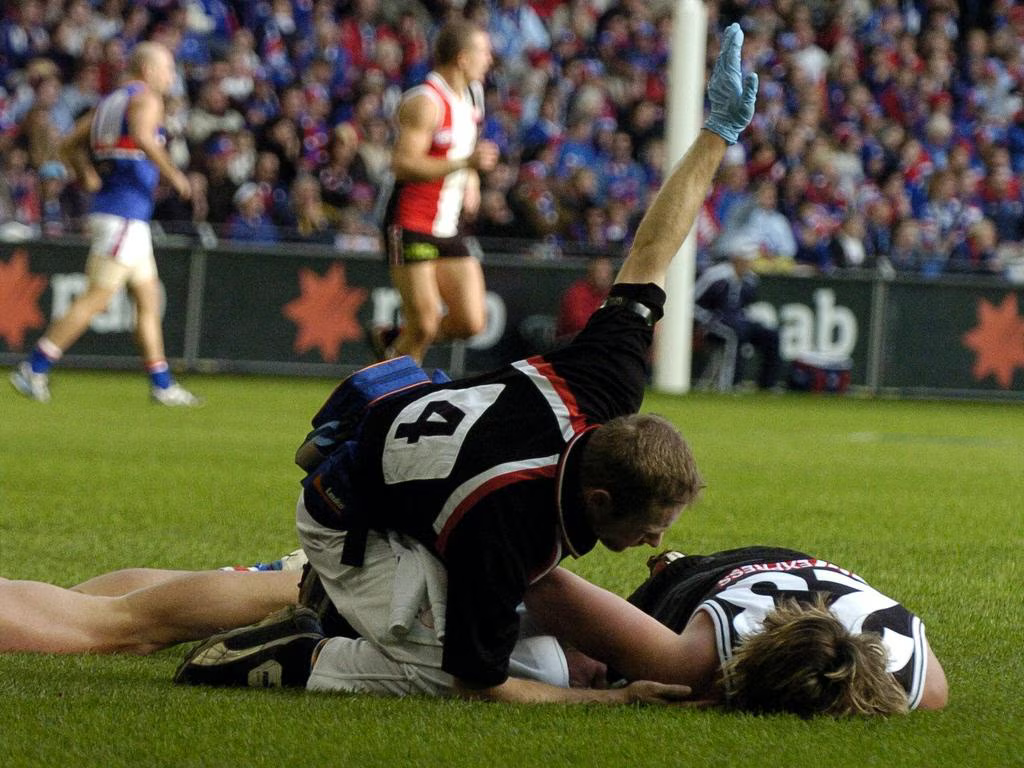
Former St Kilda star Justin Koschitzke, who suffered a horrific collision in 2006, last year admitted he felt “dizzy” and “not ready” to return in his comeback game three months later, and should not have played again.
“I have a brain injury,” Koschitzke said on Channel 7.
“Pre getting knocked-out, none of this (symptoms) was here.
“The research and the (CTE) symptoms of people who have struggled with it and have ended up taking their lives with it – really relate to me.
“I can draw really good parallels with it.
“There would be 20 games post that (collision) where I can’t remember driving home.”
Experts including Australian Sports Brain Bank director and Associate Professor Michael Buckland and neurophysiologist, Professor Alan Pearce, are adamant training limits will slash the number of sub concussive brain impacts players’ suffer.
CTE is caused by the thousands or tens of thousands of low-to-medium force blows players sustain in their junior and senior careers.
WorkSafe previously cleared the AFL’s concussion policies in 2022 despite ignoring for a decade warnings that concussed players “should not” return to the field in the same game.
But the previous clearance took in a submission from biomechanist Andrew McIntosh in July 2020 which played down the established link between repeat head impacts and CTE.
McIntosh, who has consulted to the AFL on GameGear helmets, said the evidence CTE was “causally related to ‘sub concussive’ impacts is weak”, angering neurological experts.
ess said McIntosh’s assessment was “really damning considering what we know from the science and medicine and it falls into the big tobacco playbook of deny, defend and delay”.
“It is incontrovertible that repetitive collisions create brain traumas and there is no clinical evidence to suggest they (brain injuries) heal in 12 days,” Jess said.
Buckland was adamant CTE was caused by repeat head impacts and said “it was time everyone woke up to the fact that children, in particular, are being exposed to a risk that is not being appropriately managed.”
There are calls for the AFL to adopt Australian Sports Commission guidelines to sideline players for one year if they suffer three concussions in a 12-month period.
West Coast’s Brandon Starcevich, who suffered three concussions in eight months last year, admitted in May it was “a bit scary thinking about the future”.
A Boston University study involving almost 20,000 NFL players this week found they were four times more likely to die from neurodegenerative disease than the general population due to repeat head impacts.
It comes as Richmond hard nut Jack Ross faces a lengthy stint on the sidelines after suffering his second concussion in five weeks in the loss to Carlton on Saturday night.